When a relationship comes to an end, one question often creates more stress than any other:
“Who gets to stay in the family home?”
For most couples, the family home is about much more than the building itself. It’s where memories have been made, children have grown up, and countless milestones have been shared. It’s also likely to be one of the biggest financial investments you’ll ever make, so it’s no surprise that deciding who stays can become an emotional issue.
The good news is that family mediation doesn’t decide a winner or loser. Unlike a judge, a mediator doesn’t choose who keeps the house. Instead, mediation helps both people explore fair, practical, and legally informed solutions that work for their unique circumstances.
At Barker Mediation , we know that no two families experience separation in the same way. Whether you’re ending a marriage, dissolving a civil partnership, or separating after living together, our experienced mediators are here to help you have constructive conversations and explore practical solutions in a confidential, supportive setting—without the pressure or cost that often comes with going to court.
This guide explains how mediation approaches family home disputes , the factors that influence decisions, and the options available when both people want to remain in the property.
Should One Parent Automatically Stay in the Family Home Because the Children Live There?
One of the biggest misconceptions is that the parents automatically live with them and keep the house.
In reality, there is no automatic rule.
While children’s welfare is an important consideration, mediation considers the whole picture rather than making assumptions.
During mediation, both parties have the opportunity to explain:
- Why remaining in the property is important
- Their financial circumstances
- Their housing needs
- Their future plans
- The practical impact on the children
- Whether alternative housing is realistic
Keeping children in familiar surroundings often provides steadiness during separation, particularly if they can remain close to school, friends and extended family. Separating With Children: What Are Your Options in the UK?
However, this doesn’t necessarily mean one parent permanently keeps the family home . Sometimes staying in the property is only a temporary arrangement until finances can be resolved.
At Barker Mediation , discussions remain balanced and impartial, assuring both individuals have an equal opportunity to be heard.
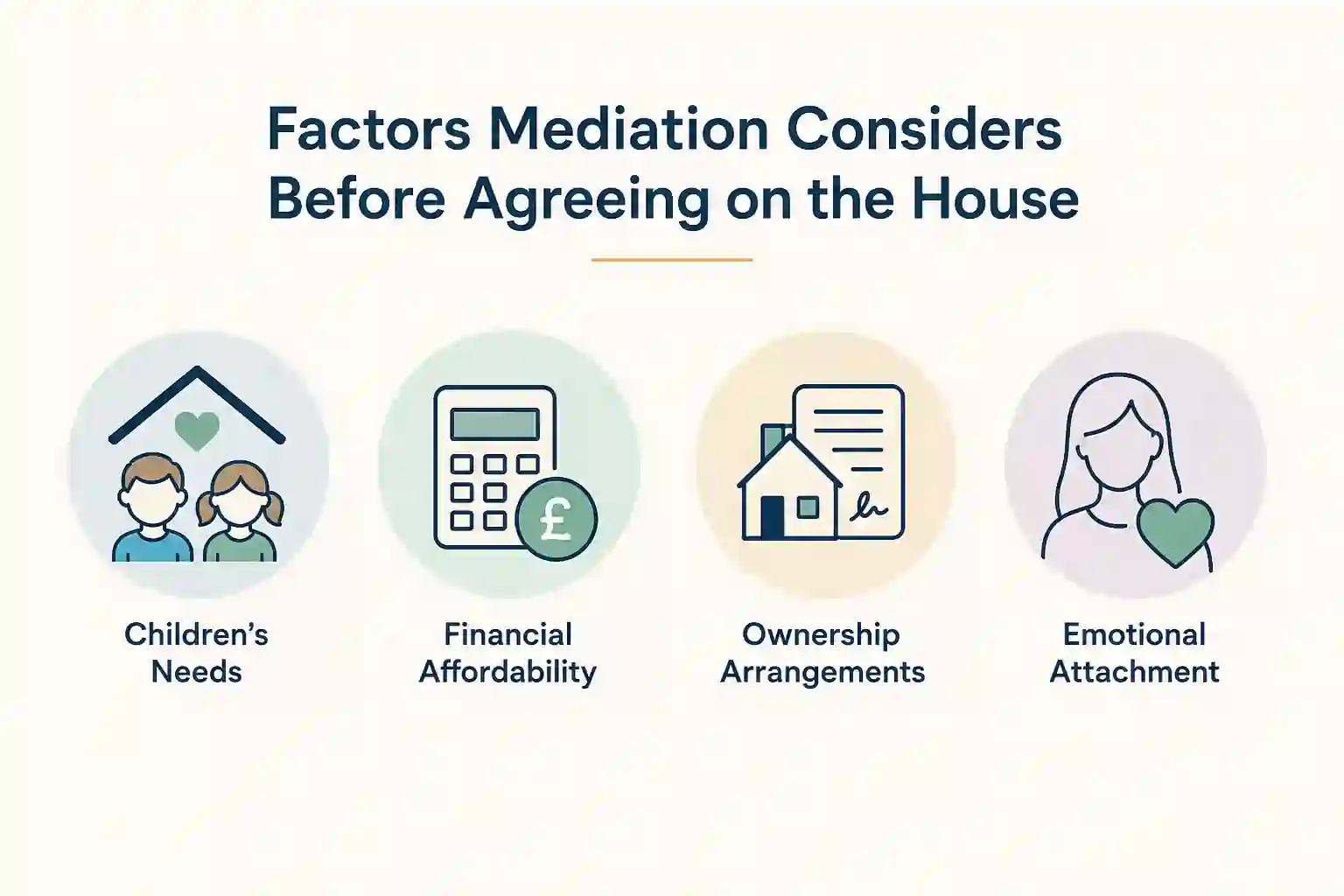
What Factors Does Mediation Consider Before Reaching an Agreement About the House?
Unlike a court, mediation doesn’t impose decisions.
Instead, an experienced mediator helps both parties examine every practical factor that could influence a fair outcome.
These discussions commonly include:
The needs of any children
Children’s routines often become central to property discussions.
Questions may include:
- Can children remain at their current school?
- Will they have enough space?
- How disturbing would moving be?
- Can both parents continue spending quality time with them?
The aim is to reduce unnecessary disruption wherever possible.
Financial affordability
Sometimes, both people wish to remain in the family home, but only one can realistically afford it.
During mediation, you’ll look at the bigger financial picture together, including:
- Monthly mortgage payments
- Household running costs
- Income and regular outgoings
- Child or spousal maintenance, where applicable
- Future earning capacity
- Existing loans and other financial commitments
Taking an honest look at these factors helps ensure that any agreement is practical and sustainable, rather than creating financial pressure later on.
Emotional attachment
While financial facts matter, emotional factors shouldn’t be ignored.
The family home often represents security, familiarity and continuity.
Mediation gives both people the opportunity to explain why remaining in the property matters personally, helping each understand the other’s perspective.
Ownership arrangements
The legal ownership of the property also matters.
This may include looking at:
- Whether the property is jointly or solely owned
- The amount of equity available
- Any remaining mortgage balance
- Financial contributions made by each person over the years
Every separation comes with its own set of circumstances, so these issues are explored thoroughly to ensure any agreement reflects the needs of everyone involved.
What If Neither of Us Can Afford to Buy the Other Out?
This is one of the most common situations that couples face. Many people assume their only option is to sell the property immediately.
In reality, mediation often uncovers alternatives that neither person had previously considered. Am I Eligible for Legal Aid for Family Mediation in the UK?
Possible options may include:
Selling the property
Selling allows both parties to divide available equity and make a fresh start.
Although emotionally difficult, it can provide financial certainty.
Buying out the other person’s share
If one partner can obtain mortgage approval and afford the ongoing repayments, they may purchase the other partner’s interest in the property.
This enables one person to remain while fairly compensating the other.
Delayed sale agreements
Sometimes the family home isn’t sold immediately.
Instead, both parties agree to delay the sale until a future event, such as:
- Children reach a certain age.
- Completion of education
- Financial circumstances improving
This can offer greater stability while allowing more time to plan.
Continuing joint ownership temporarily
Some separating couples agree to remain joint owners for a period while living separately.
Although this isn’t suitable for everyone, mediation allows both people to discuss whether such an arrangement is practical.
At Barker Mediation , every option is explored openly so that couples understand the advantages, risks and long-lasting consequences before making decisions.

How Can Mediation Reduce Conflict When Emotions Are Running High?
Disagreements about the family home often become emotionally charged because both people feel they’re losing something significant.
Arguments can quickly become repetitive, with each conversation ending in frustration.
Mediation creates a more supportive environment for these conversations. Rather than trying to resolve everything on your own, both of you meet with a neutral mediator who helps keep discussions focused, balanced, and productive. Financial Mediation on Separation: Property, Pensions and Debt
This helps by:
- Keeping conversations respectful
- Allowing each person uninterrupted time to speak
- Concentrating on practical solutions instead of blame
- Decreasing misunderstandings
- Examining options neither person had previously considered.
- Encouraging decisions that both people can live with
Many couples are surprised to discover they reach agreements more quickly once communication becomes structured.
In cases where direct discussions are particularly difficult, mediation can often be arranged in separate rooms or online sessions, lessening unnecessary conflict while keeping negotiations moving forward.
Why Do So Many Families Choose Barker Mediation to Resolve Property Disputes?
When emotions are high, it’s easy to become focused on “winning” the house.
However, successful mediation isn’t about winners and losers.
It’s about helping families move forward with dignity, fairness and practical solutions.
At Barker Mediation , we acknowledge that every family’s financial circumstances, parenting arrangements and housing needs are different.
Our experienced mediators provide a safe, impartial setting where both individuals can discuss concerns openly while working towards realistic agreements.
Clients choose Barker Mediation because we help them:
- Resolve disagreements free of unnecessary conflict.
- Explore every realistic housing option.
- Keep discussions child-focused where appropriate.
- Reduce the stress and cost associated with court proceedings.
- Improve communication during an already difficult time.
- Create practical agreements that work for the future.
Whether you’re uncertain about selling the family home , buying out a partner or simply understanding your options, mediation provides a constructive route forward that puts solutions ahead of confrontation.

Common Questions Clients Ask
Q: If we both want to stay in the family home after separating, can mediation actually help us reach an agreement without either of us feeling pressured?
Absolutely. The purpose of mediation is to create a safe and respectful space for the two of you to discuss your concerns and priorities. A mediator doesn’t tell either person what they should do, but facilitates a back-and-forth conversation so you can examine scenarios for plausibility and move towards achieving something realistic that everyone thinks is at least fair.
Q: Will the person who spends more time caring for our children automatically be allowed to remain in the family home ?
Not automatically. While children’s welfare is an important consideration, mediation also looks at affordability, housing needs, ownership arrangements, financial circumstances, and the long-term practicality of any proposed solution.
Q: What happens if neither of us can realistically afford to keep the family home on our own after separation?
If neither of you can afford to keep the property, mediation can help you explore practical alternatives. These might include selling the family home , delaying the sale, or agreeing on a temporary arrangement that works for everyone.
Q: Can mediation help if the house is owned solely in one person’s name, but both of us have lived there for years?
Yes. Even if only one person legally owns the property, mediation can help you discuss financial contributions, future housing needs, and possible solutions before turning to court.
Q: How does Barker Mediation keep discussions about the family home constructive when emotions are running high?
It’s completely normal for conversations about the family home to be emotional. At Barker Mediation , our mediators help keep discussions calm, respectful, and focused on finding solutions instead of dwelling on past disagreements. By giving each person an equal opportunity to speak and be heard, we help create a more productive environment where practical decisions can be made with greater confidence.
Q: Is reaching an agreement through Barker Mediation usually quicker and more cost-effective than asking a court to decide who stays in the family home?
In many cases, yes. Mediation is often significantly faster, less expensive, and less stressful than court proceedings. It also allows both people to remain in control of the outcome instead of leaving such an important decision to a judge.
For Further Information, please Call Us ON 03300 100 151