When family disputes arise, it’s natural to want a quick legal solution. Many people believe that going straight to court will resolve matters faster, especially if communication has completely broken down. However, in many family law cases in England and Wales, the court expects people to consider mediation before issuing an application.
So, can you go straight to court without trying mediation?
The answer depends on your circumstances. While mediation is strongly encouraged and often required before making certain court applications, there are important exceptions. Understanding these rules can save you time, money and unnecessary stress.
At Barker Mediation , we regularly help individuals and families understand whether mediation is suitable for their situation and whether they need an MIAM before applying to court. This guide explains everything you need to know in simple, practical language.
Do I Have to Try Mediation Before Going to Court in the UK?
This is one of the most common questions people ask after a separation or family disagreement.
Before applying to the family court for many disputes involving children or finances, you’ll often be expected to attend an MIAM.
A MIAM is not mediation itself.
Instead, it is an individual meeting with a qualified mediator who explains:
- How mediation works
- Whether mediation is suitable
- Alternative ways to resolve the dispute
- Whether your case qualifies for an exemption
The purpose isn’t to force you into mediation. It’s simply to ensure you’ve considered whether a less confrontational and more cost-effective solution could work.
If mediation is considered unsuitable or one person refuses to participate, the mediator can sign the necessary court forms allowing you to proceed.
This process helps reduce unnecessary court cases while giving families the opportunity to reach agreements more quickly and with less conflict.
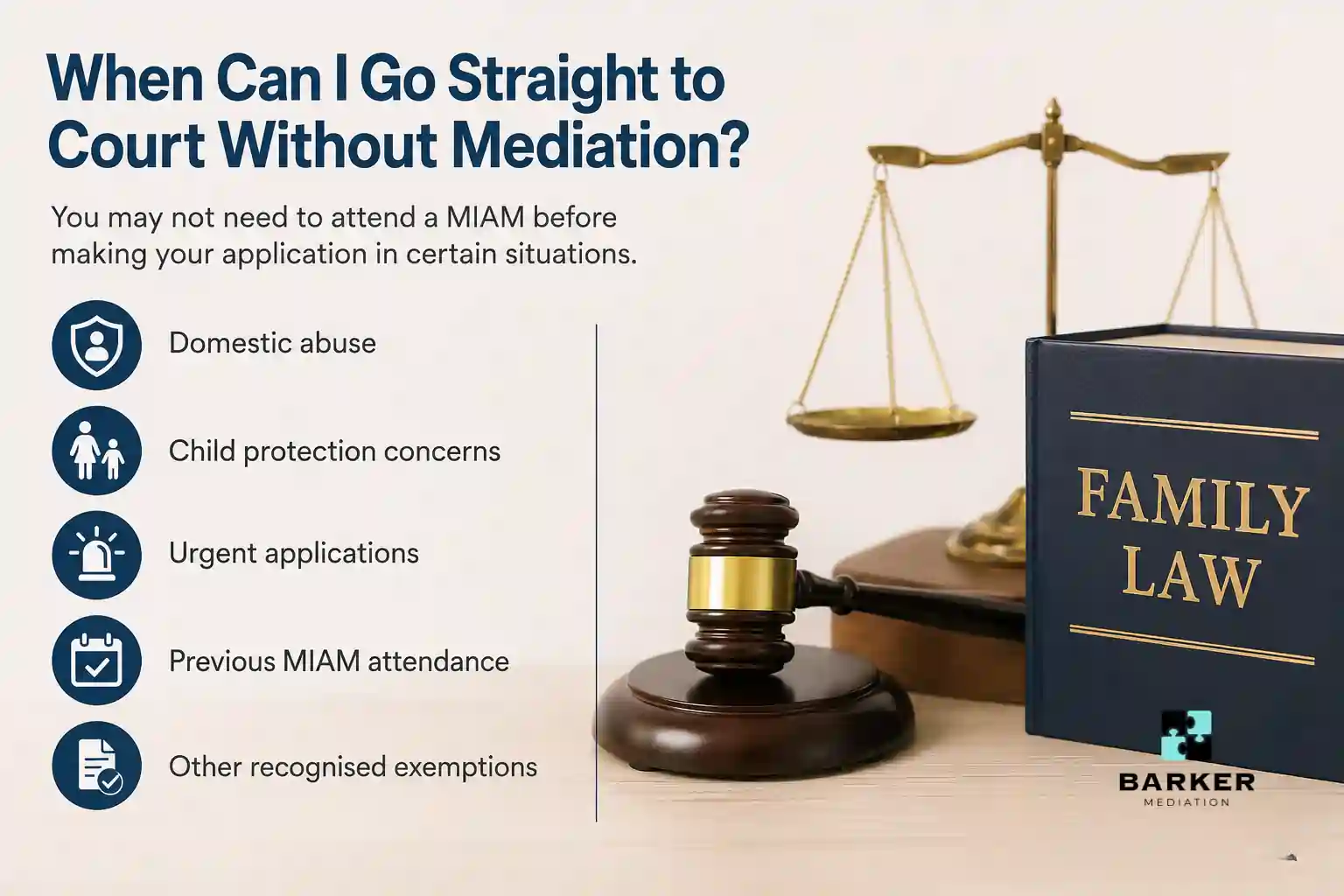
When Can I Go Straight to Court Without Mediation?
Although mediation is encouraged, there are situations where you may not need to attend a MIAM before making your application.
Common exemptions include:
Domestic abuse
If you’ve experienced domestic abuse and have acceptable evidence, you may be able to apply directly to court.
Child protection concerns
Where there is an immediate risk to a child’s safety or welfare, urgent court intervention may be appropriate.
Urgent applications
Cases involving immediate danger, unlawful removal of a child, or other urgent circumstances may qualify for an exemption.
Previous MIAM attendance
If you’ve already attended a qualifying MIAM within the required timeframe, another meeting may not be necessary.
Other recognised exemptions
There are several additional exemptions depending on the facts of your case and the type of application being made.
Because exemption rules can be complex, obtaining professional guidance before submitting court paperwork is always advisable.
At Barker Mediation , we help clients determine whether they need a MIAM or whether they qualify for an exemption, reducing the risk of court delays caused by incomplete applications.
What Happens If the Other Person Refuses to Attend Mediation?
Many people worry that mediation will only work if both parties cooperate.
Fortunately, the process doesn’t stop simply because one person refuses.
Here’s what usually happens:
- You attend your MIAM.
- The mediator contacts the other person and invites them to participate.
- They can choose whether to attend.
- If they decline or fail to respond, the mediator records this.
- You can then continue with your court application where appropriate.
The court generally wants to see that you’ve made a genuine attempt to explore alternatives before litigation.
The refusal of the other party does not prevent you from accessing the court system.
This protects individuals from becoming stuck simply because someone else refuses to engage.
Is Going Straight to Court Always the Best Option?
Not necessarily.
Going to court can be a long, emotionally draining, and expensive process.
Many families assume litigation will provide quicker answers, but in reality, court timetables can extend over many months depending on the complexity of the case.
Mediation offers several advantages:
Faster resolutions
Many family disputes are settled within weeks instead of taking months.
Lower legal costs
Mediation is usually significantly less expensive than contested court proceedings.
Greater control
Instead of having a judge make decisions, both parties retain greater influence over the outcome.
Reduced conflict
Constructive discussions often help preserve communication, particularly where children are involved.
Flexible solutions
Agreements reached through mediation can often be tailored to the family’s specific circumstances rather than following a strict court order.
Of course, mediation isn’t suitable for every situation. Where there are safeguarding concerns, coercive behaviour or urgent legal issues, court intervention may be entirely appropriate.
The key is understanding which route best suits your individual circumstances.
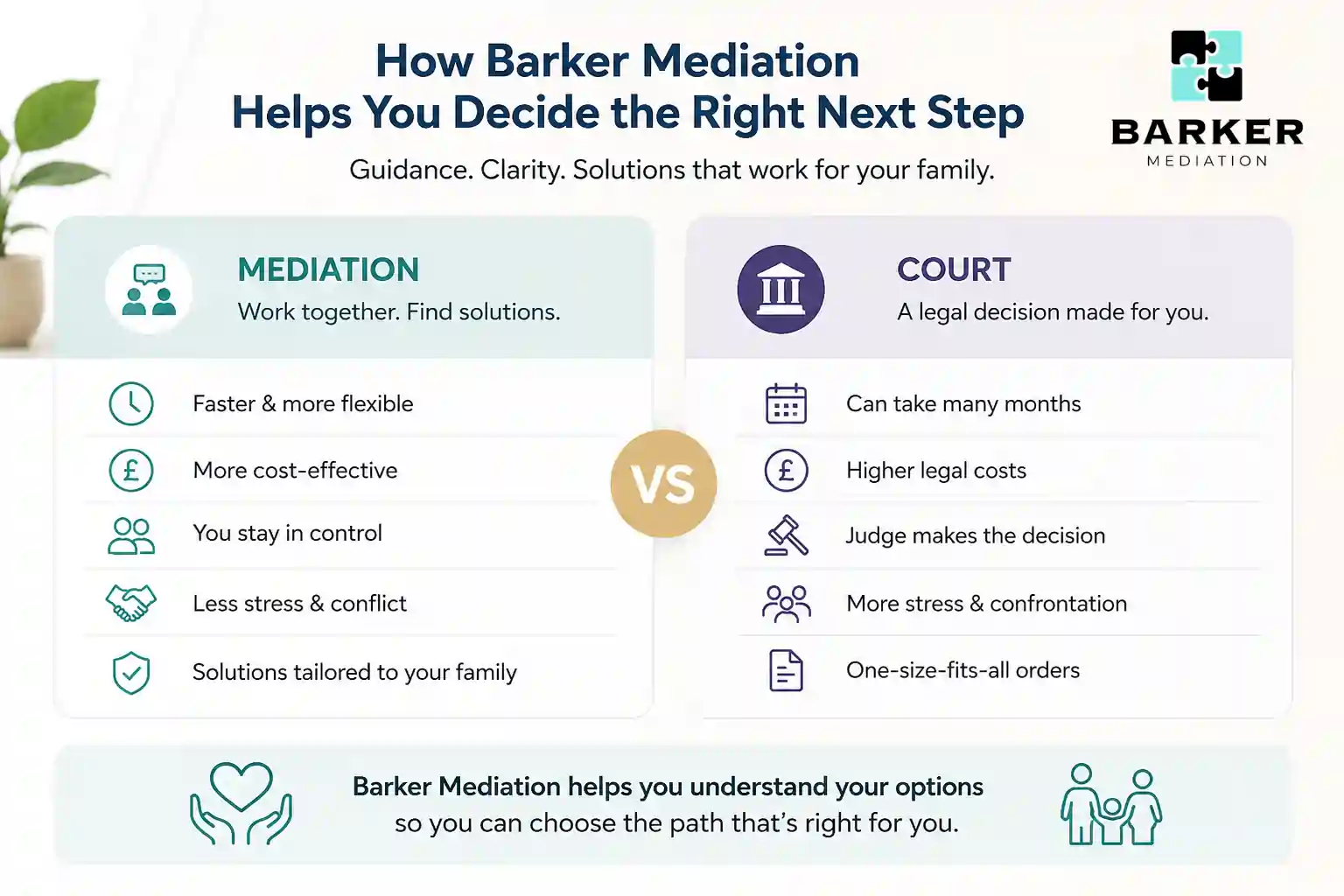
How Can Barker Mediation Help Me Decide the Right Next Step?
Every family dispute is different.
Some people benefit enormously from mediation, while others need immediate legal action.
At Barker Mediation , we don’t believe in a one-size-fits-all approach. Our experienced mediators offer practical, impartial guidance, taking the time to understand your concerns before helping you decide on the most suitable next steps.
Whether you’re dealing with:
- Child arrangements
- Financial settlements
- Property disputes
- Communication breakdowns
- Divorce-related disagreements
We can assess whether mediation is appropriate or whether your case is likely to require court proceedings.
Our MIAM appointments are designed to provide straightforward, impartial advice without pressure or unnecessary legal jargon.
If mediation is suitable, we’ll guide you through the process professionally and sensitively.
If the court is the appropriate route, we’ll ensure you have the correct documentation needed to move forward confidently.
Our aim is always to help families resolve disputes as efficiently, respectfully and cost-effectively as possible.
Common Questions Clients Ask
Q: Can I apply to court immediately if my ex-partner refuses to attend mediation ?
Yes. If you attend your MIAM and the other person declines mediation or ignores the invitation, the mediator can usually complete the relevant paperwork, allowing you to proceed with your court application.
Q: Do all family court applications require mediation before they can be submitted?
No. While many applications involving children or finances require a MIAM, certain cases qualify for exemptions, including those involving domestic abuse, urgent matters or child protection concerns.
Q: What evidence do I need if I believe I qualify for a mediation exemption ?
The evidence required depends on the exemption being claimed. For example, domestic abuse exemptions may require police reports, court orders or letters from relevant professionals. A qualified mediator can explain what documentation is acceptable.
Q: Will attending a MIAM delay my court case if mediation is clearly unsuitable?
In most cases, no. A MIAM is usually a short assessment meeting that helps determine whether mediation is appropriate. If it isn’t suitable, you’ll normally receive the necessary certification to continue with your court application.
Q: Is mediation legally binding if we reach an agreement ?
The discussions during mediation are not automatically legally binding. If an agreement is reached during mediation, it can usually be made legally binding by asking a solicitor to turn it into a court order, where appropriate.
Q: How can Barker Mediation help if I’m unsure whether I need mediation or court?
Barker Mediation provides professional MIAM assessments, explains your legal options, identifies whether any exemptions apply and helps you decide whether mediation or court is the most appropriate route based on your individual circumstances. Our goal is to help you move forward with clarity, confidence and the right support for your situation.
For Further Information, please Call Us ON 03300 100 151